Artificial Intelligence is transforming enterprise security, governance, internal audit, and risk management faster than ever before. But is AI replacing professionals, or enabling them to make better decisions?
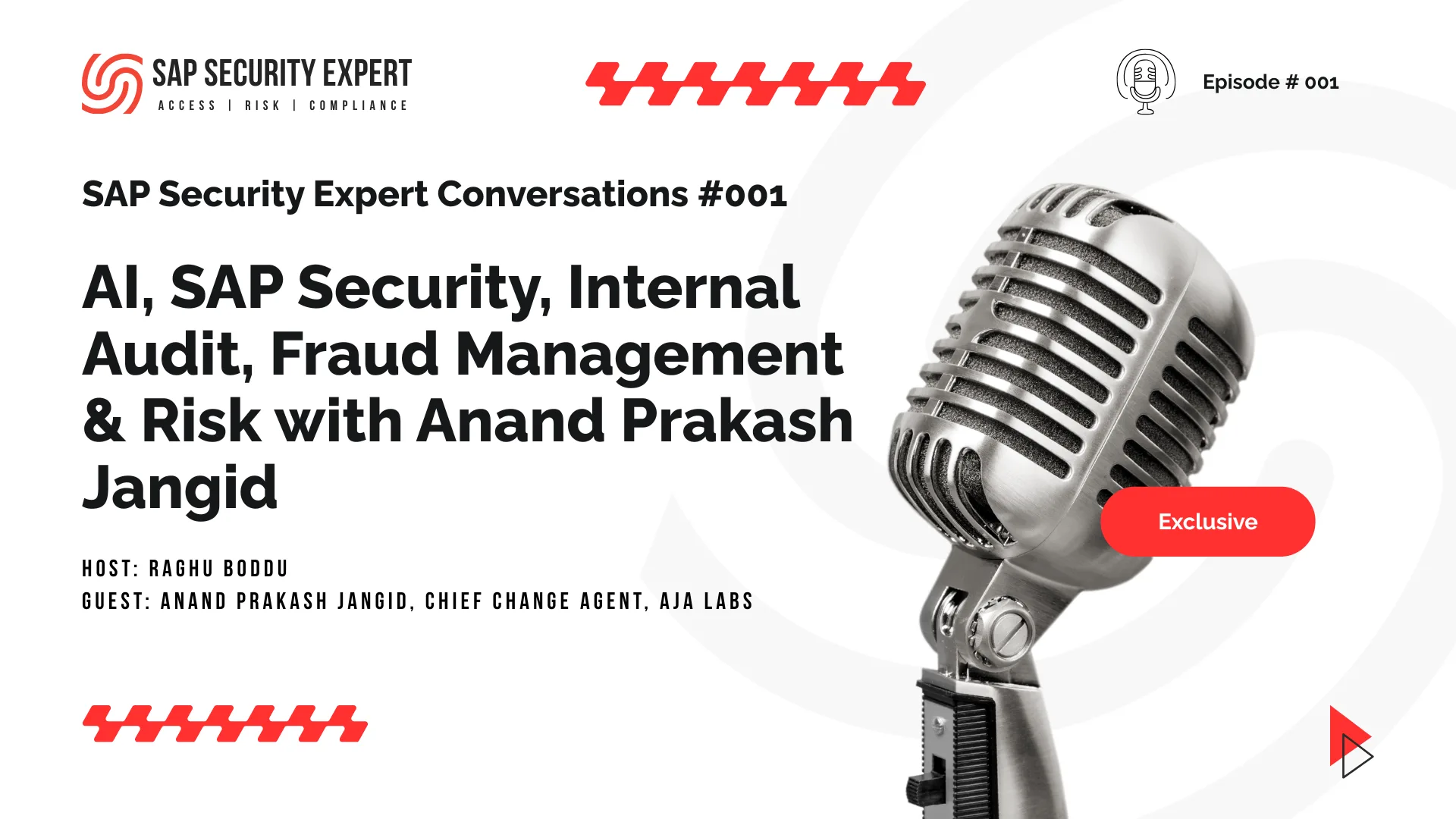
In the inaugural episode of SAP Security Expert Conversations, Raghu Boddu sits down with Anand Prakash Jangid, Chief Change Agent at AJA Labs, to discuss how AI is reshaping SAP Security, Governance, Risk & Compliance (GRC), internal audit, fraud detection, data privacy, and enterprise automation.
Drawing on decades of experience across Goldman Sachs, Infosys, academia, and AI product development, Anand shares practical insights into continuous control monitoring, autonomous auditing, data-driven governance, AI guardrails, and why future professionals must combine business expertise with technology skills.
Whether you're an SAP Security consultant, GRC professional, auditor, finance leader, or cybersecurity practitioner, this episode offers actionable perspectives on the future of enterprise governance.
What You'll Learn
- Why AI should augment, not replace - human judgment
- How internal audit is evolving from sample-based testing to continuous auditing
- The future of Segregation of Duties (SoD) in modern enterprises
- How AI is transforming fraud detection and enterprise risk management
- Why Continuous Control Monitoring (CCM) is becoming autonomous
- Practical implications of India's Digital Personal Data Protection Act (DPDPA)
- Risks of Generative AI, hallucinations, and AI governance
- Why "Purple People" (business + technology professionals) will shape the future
- Career advice for SAP Security and GRC professionals
Key Takeaways:
- AI should enhance professional judgment rather than replace it.
- Continuous auditing is replacing traditional sample-based audit approaches.
- Future SAP Security professionals need both technical expertise and business knowledge.
- Organizations should focus on proactive governance instead of compliance-only thinking.
- AI adoption requires strong governance, human oversight, and effective guardrails.
- Continuous Control Monitoring enables organizations to identify risks much earlier.
- DPDPA will significantly influence enterprise data governance strategies.
- Successful AI implementations require understanding business processes -not just technology.
About the Guest
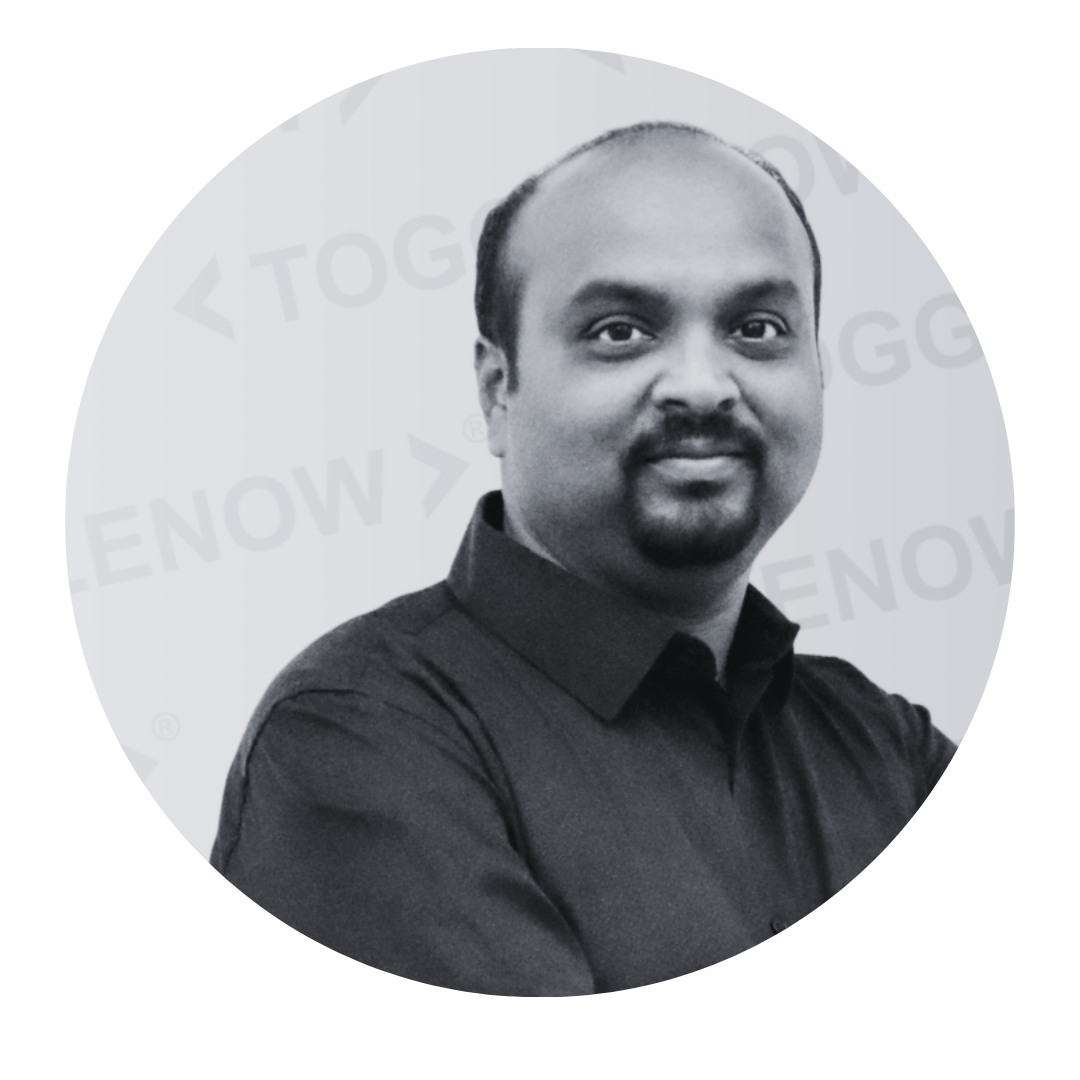
Anand Prakash Jangid is the Chief Change Agent at AJA Labs ( https://www.ajalabs.ai/ ), where he leads AI-driven innovation in audit, finance, risk management, and enterprise automation. His career spans anti-money laundering investigations at Goldman Sachs, enterprise risk management at Infosys, academic engagements with premier institutions, and the development of AI-powered enterprise solutions for SAP and Oracle ecosystems.
About the Host
Raghu Boddu is a globally recognized SAP Security and GRC expert with over 25 years of experience helping enterprises strengthen security, governance, compliance, and cyber resilience. He leads Product Innovation at ToggleNow ( https://www.togglenow.com ) and is the Co-Founder. He is also an SAP Press author, and Founder of SAP Security Expert Community.
Listen on:
Spotify | Apple Podcasts | YouTube Music | Amazon Music
This is an edited transcript of the conversation. It has been refined for clarity and reading flow while preserving the original meaning, tone, and intent of the discussion. It is not a verbatim transcript.
Chapter 1 - Welcoming
Raghu Boddu
Welcome to the first episode of SAP Security Expert Conversations, a series led by SAP Security experts for the SAP Security community.
Today, I have a very special guest. He doesn't call himself a CEO, CFO, or CTO. Instead, he has chosen a unique title - Chief Change Agent. Once you hear him speak, you'll understand why.
Joining me today is Anand Prakash Jangid - a Chartered Accountant, cybersecurity professional, educator, and a well-known speaker across various industry forums.
Personally, I've invited Anand to several events and podcasts over the years. Whenever I need to discuss topics such as fraud management, risk management, or internal audit, he's one of the first people I reach out to.
Anand has worked on Anti-Money Laundering (AML) investigations at Goldman Sachs in Tokyo before moving to Infosys. Today, he leads AJA Labs, an AI-driven organization focused on building innovative solutions for finance, audit, governance, and risk.
Anand, welcome to SAP Security Expert Conversations.
Anand Prakash Jangid
Thank you, Raghu. It's truly a pleasure to be here.
Raghu Boddu
SAP Security Expert is a niche platform that we're building to bring together knowledge, experiences, and insights from industry experts so we can share them with the broader SAP Security and GRC community.
Having you as one of our guests is truly special.
Before we get into the discussion, I have to ask the obvious question.
You don't use a conventional title like CEO or Managing Director. Instead, you call yourself Chief Change Agent.
What's the story behind that?
Anand Prakash Jangid
That's a great question, Raghu.
First of all, thank you for inviting me. The respect is completely mutual. In fact, I've told you this before - I have your contact saved in my phone as "SAP Security Expert." That's genuinely how I think of you.
Coming back to your question...
Over the years, I've spent a lot of time reading, researching, and working with academicians at IIM Bangalore. One idea that really resonated with me was the role of a Change Agent during any transformation.
When we started AJA Labs, our vision was to become change agents for the finance and audit domain by bringing smarter technology into enterprise environments, especially SAP and Oracle landscapes.
Instead of calling ourselves consultants, we felt our real responsibility was helping organizations embrace change.
I have an amazing team of talented people, and together we work on introducing new ideas and new ways of solving business problems.
Whenever we meet customers, we're often introducing concepts they've never tried before. That requires helping them think differently and adopt new approaches.
That's why we chose the title Chief Change Agent.
My role is to lead that transformation and ensure our team helps customers successfully embrace change.
That's the story behind the title.
Raghu Boddu
I really like that.
In fact, change isn't something that's coming tomorrow.
Change is happening now.
Chapter 2 - Anand's Journey
Raghu Boddu
You've had a fascinating career.
From being a Chartered Accountant to working at Goldman Sachs, then Infosys, and now building AI-powered products through AJA Labs.
Can you walk us through that journey?
Anand Prakash Jangid
It's been quite an interesting journey.
People often ask how someone from a Chartered Accountancy background ended up building AI products.
I've always believed that technology and business should complement each other.
During my corporate career, I worked extensively in audit, finance, governance, and enterprise technology. Those experiences helped me understand that data, when used correctly, can solve many business problems.
That naturally led us toward product development.
Another important turning point in my life was my interest in academics.
Working with institutions like IIM Bangalore exposed me to research, innovation, and emerging technologies. I realized there was tremendous value in combining practical industry experience with academic thinking.
Unfortunately, life also taught me another lesson.
I had a few health challenges, including a minor heart attack that required a stent. That experience completely changed my perspective.
I decided to step away from the corporate world for some time and spend more time in academia, teaching, learning, and building products.
Even today, teaching excites me because whenever you're facilitating a class, you have to know the subject better than the audience. It forces you to keep learning continuously.
Recently, I came across a term that perfectly describes this combination of industry and academics.
It's called Practidemia - a blend of Practitioner and Academia.
That's exactly what I'm trying to become.
I'm not saying I've mastered it, but I'm continuously working towards it.
We spend a lot of time reading research papers, exploring new algorithms, and understanding how they can solve practical business problems.
That's been my journey so far.
Raghu Boddu
That's a wonderful way of looking at it.
You're combining the best of both worlds - industry experience and academic research.
Chapter 3 - Will AI Replace Jobs?
Raghu Boddu
Anand, you're a Chartered Accountant, you understand technology, and you've worked with large organizations and system integrators. Today, with Artificial Intelligence and Machine Learning evolving so rapidly, and with AJA Labs building products in this space - I'd like to hear your perspective.
Do you think technology is replacing jobs, or is it simply removing inefficiencies? What's your view?
Anand Prakash Jangid
That's probably the million-dollar question today. Everyone is talking about it, and a lot has already been written on the subject.
If you remember the early days of SAP, many of us believed our jobs were secure for life because SAP was such a vast ecosystem. We used to say, "We'll always have something to do."
Today, AI has become the new disruptor.
My personal view is that professionals need dual expertise. Technology is increasingly becoming a given. In fact, at one of the SAP TechEd events, I came across the term Citizen Developer. The idea was that, over time, business users themselves would build solutions, and we're already seeing that happen with SAP Joule and similar technologies.
What will make someone irreplaceable is the combination of functional expertise and technology knowledge.
Whether you're an expert in sales, finance, procurement, or any other business process, if you also understand technology, you become extremely valuable.
The same applies in reverse. Developers need business knowledge just as business professionals need technical knowledge. Even during my Infosys days, domain knowledge was considered critical.
So no, I don't think AI will replace people.
But I do believe roles will change significantly.
At AJA Labs, for example, our Chartered Accountants and engineers work together to build solutions. That collaboration is very different from how organizations operated a few years ago.
That's my perspective.
Chapter 4 - Human Judgment vs. Artificial Intelligence
Raghu Boddu
Since you're also a Chartered Accountant, let me ask you something specifically from an auditor's perspective.
What is the one responsibility that should never be handed over completely to a machine?
Anand Prakash Jangid
That's a very good question.
I would say judgment.
Machines can analyze enormous amounts of data. AI systems can process information, identify patterns, and make recommendations.
But the final judgment should always remain with humans.
I've always believed in the concept of a Human in the Loop.
No matter how autonomous our systems become, there should always be a human making the final decision.
Take treasury management as an example. We can build excellent AI-driven solutions for treasury operations in SAP or any other platform. But the final call should still be made by the Treasury Manager who understands the business context.
AI is extremely powerful, but we still need human control points.
That's where humans continue to make the difference.
Chapter 5 - AI in Internal Audit
Raghu Boddu
One thing I've always associated with you is AI in IA.
In fact, I remember seeing that printed on your T-shirt as well.
Tell us a little about that journey.
Anand Prakash Jangid
(Laughs)
Yes, that's true.
People sometimes ask whether "AI in IA" stands for the Indian Army.
I tell them, "No, it's Internal Audit!"
It's been our tagline for quite a long time.
We started working on Artificial Intelligence for Internal Audit several years ago because we believed audit was one area where technology could make a tremendous impact.
Internal Audit deals with large volumes of enterprise data. Instead of reviewing only a small sample, we wanted to explore how AI could help auditors analyze entire populations and generate better insights.
That vision continues to drive us today.
Chapter 6 - Moving Beyond Sampling
Raghu Boddu
That actually brings me to another important question.
Most security professionals and GRC consultants participate in internal and external audits. In many cases, audits are still performed using sampling. Every transaction isn't reviewed.
How do you see AI changing this?
Anand Prakash Jangid
That's one of the most exciting developments happening today.
The days of relying only on sampling are gradually coming to an end.
If we're still depending solely on sampling, we're actually limiting ourselves.
Today, we have the computing power to analyze complete populations instead of just a subset.
I've seen some of the work your team has done in this area, and it's genuinely impressive.
Audit Committees are also changing. In fact, I was recently speaking at an Institute of Directors event, and it's clear that Audit Committees are becoming much more proactive.
This means governance is no longer the responsibility of auditors alone.
It's a shared responsibility between Audit Committees, GRC professionals, business teams, and auditors.
We're moving from detective controls to preventive controls.
One concept I find particularly exciting is the idea of a Digital Twin - similar to what SAP GRC Access Control has enabled for years through access simulations.
Imagine being able to simulate the impact of granting access before actually assigning it.
I believe these capabilities will soon become mainstream.
Chapter 7 - Risk Management Has Evolved
Raghu Boddu
That's a great point.
Risk management today is very different from what it was ten or fifteen years ago.
Back then, we mainly looked at traditional Segregation of Duties scenarios - for example, ensuring that the person creating a vendor wasn't also able to release payments.
As long as those duties were separated, everyone was satisfied.
But recently, we came across a customer where the SoD rules were perfectly configured. The conflicting activities were assigned to different users.
However, the same individual knew another user's credentials, logged in using those credentials, and performed the conflicting transaction anyway.
Today, risk management goes far beyond traditional SoD rules.
Cases like these can be identified much more effectively with AI, can't they?
Anand Prakash Jangid
Very much.
It's no longer enough to look only at static Segregation of Duties rules.
Organizations need to understand user behavior, transaction patterns, and contextual risks.
That's where AI can make a real difference.
It allows organizations to move beyond traditional compliance checks and identify risks that were previously very difficult to detect.
Chapter 8 - Risk Management Beyond Traditional SoD
Raghu Boddu
Exactly. That's the point I wanted to make.
Risk management today is very different from what it was 10 or 15 years ago.
Earlier, we primarily focused on traditional Segregation of Duties (SoD). For example, ensuring that the person creating a vendor couldn't also release a payment. If those activities were separated, everyone was happy.
But recently, while working with a customer, we found something interesting.
From an SoD perspective, the controls were perfectly designed. The activities were assigned to different users. However, the same individual logged into the system, modified the vendor master, and then used another person's credentials to perform the conflicting activity.
So today, risk management goes far beyond traditional SoD rules.
Cases like these can be identified much more effectively with AI, can't they?
Anand Prakash Jangid
Very much.
That's exactly where the next generation of risk management is heading.
Chapter 9 - Beyond Compliance
Raghu Boddu
Another point I'd like to highlight for everyone listening to this podcast is that governance today should go far beyond compliance.
Many organizations still approach audit with a checkbox mentality. If they've passed the audit, they assume everything is fine.
But that's no longer enough.
What's your perspective?
Anand Prakash Jangid
You're absolutely right.
There are still organizations that aim for what I would call the minimum level of compliance. They satisfy the audit requirements, complete the certifications, and move on.
But that's not necessarily in the organization's best interest.
Over the last seven or eight years, we've seen regulations become much stricter. Auditors are becoming more assertive, and governance expectations are increasing.
Today, we're seeing situations where auditors resign, share prices are affected, and governance failures have a direct business impact.
A new generation of auditors is emerging - professionals who are much more proactive and focused on identifying real risks rather than simply completing compliance checklists.
It's an interesting shift that's happening across the industry.
Chapter 10 - Reputation Matters More Than Compliance
Raghu Boddu
I think, beyond compliance and beyond audit mandates, what ultimately matters is reputation.
At the end of the day, that's what organizations need to protect.
Anand Prakash Jangid
Absolutely.
Reputation is extremely important.
If organizations invest a little time in building the right controls, those controls eventually become part of their Business as Usual (BAU) operations.
That's where technology becomes an accelerator.
I've seen some of the solutions you're building. Once they're configured correctly, they simplify governance and make life much easier.
Organizations, whether they like it or not, will increasingly need these kinds of accelerators to perform governance activities faster and more effectively.
Chapter 11 - Building Multiple Products at AJA Labs
Raghu Boddu
Let me ask you a slightly longer question.
You've developed more than eight products spanning areas such as Continuous Control Monitoring, Gross-to-Net, Forensics, Legal, Supply Chain, Entity Health, and several others.
Fortunately, we're not competing - we're complementing each other.
I have two questions.
First, did you intentionally build a portfolio of products, or were you building a larger platform from the beginning?
Second, when you speak to SAP customers about products like Compliance Monitoring or Forensics, do you think organizations truly understand what these products can do? What's been the market response?
Anand Prakash Jangid
That's a great question.
Let me answer it in two parts.
We actually started as a consulting organization. We never planned to become a product company.
During our consulting engagements, we kept solving similar business problems again and again. Some of our mentors encouraged us to think differently. They said, "You're already solving these problems repeatedly. Why not build products around them?"
That was the beginning of our product journey.
There's another reason we call ourselves AJA Labs.
The word Labs reflects our culture of experimentation.
I'm sure many people have heard of the concept of the Google Graveyard - the long list of Google products that never succeeded.
Even great companies experiment.
Not every experiment succeeds, and that's perfectly fine.
We wanted to create an environment where experimentation was encouraged.
From day one, we decided to focus on only two domains:
• Audit
• Finance
We didn't want to build products for every possible business function because those weren't our areas of expertise.
Instead, we focused on solving problems within audit and finance, including adjacent areas like supply chain.
As you mentioned, we built multiple products over time.
Eventually, we grouped them under two broader ecosystems.
One of them is ComplyBear, which focuses on audit, governance, compliance, and risk management.
Products like Gross2Net were originally developed for pharmaceutical companies in the United States to address challenges around the Affordable Care Act and Gross-to-Net calculations.
Instead of treating them as standalone products, we gradually brought them together under a common platform.
Chapter 12 - Building World-Class Products from India
Anand Prakash Jangid
Another motivation was something many of us have heard over the years.
People often said that India was excellent at IT services but couldn't build world-class software products.
There was even an unfortunate term people used - "cyber coolies."
We wanted to challenge that perception.
Our thought was simple.
Maybe we'll succeed.
Maybe we'll fail.
But let's at least try to build products from India for the global market.
That led us to build another platform called Vitora, which is designed for the CFO's office. It focuses on areas such as Digital Twins, Treasury, and financial simulations.
Today, those are the two major ecosystems we're building around.
Chapter 13 - One Size Never Fits All
Anand Prakash Jangid
One more lesson significantly influenced our thinking.
We were incubated at NSRCEL, IIM Bangalore, where we had the opportunity to learn from some exceptional mentors in the SaaS ecosystem.
One piece of advice stayed with us.
They said, "You can't build a one-size-fits-all product for enterprise customers."
SAP is a perfect example.
Every SAP implementation is different.
Every customer has custom tables, custom code, custom processes, and unique business requirements.
That's why we describe our products as customizable and orchestrated products.
Around 90% of the solution is standardized, while the remaining portion is tailored to each customer's environment.
That approach has worked well for us.
It's been a journey with many pivots and a lot of learning.
We've also sought advice from many people - including you, and we've been fortunate to have customers who believed in our vision and worked with us.
So far, it's been a wonderful journey.
Chapter 14 - AI in Audit Firms
Raghu Boddu
That's an interesting observation.
I also see many leading audit firms - not just the Big Four, but several large firms - starting to use AI during audits.
We've heard of firms using AI to analyze data and generate reports instead of relying entirely on manual review.
Without naming anyone, what's your view on that?
And as a boutique firm, how does AJA Labs approach AI differently?
Anand Prakash Jangid
AI is a transformative technology.
It's similar to what the internet was when it first emerged.
I still remember the days when we stood in cyber cafés waiting for internet access.
If you tell today's generation that constant internet connectivity wasn't available back then, they'll probably laugh.
AI represents a similar shift.
But I also compare AI to fire.
Fire is incredibly useful, but only when it's handled responsibly.
The same applies to AI.
At AJA Labs, we use AI extensively, including AI agents for software development and automation.
However, every AI-generated output goes through human review.
That final validation is essential.
Recently, I wrote on LinkedIn about the risks of building AI agents without proper guardrails.
Those controls are extremely important.
I remember auditing Robotic Process Automation (RPA) implementations years ago.
In one case, we discovered that the root credentials of a core banking system had been embedded directly into an automation script.
That experience reinforced an important lesson.
Automation without governance creates new risks.
AI is no different.
Organizations need strong controls, governance frameworks, and human oversight to ensure AI is used responsibly.
Chapter 15 - Are AI Audit Tools the Future?
Raghu Boddu
Continuing on the topic of AI, I also see many large audit firms - not just the Big Four, but several leading firms in India - starting to use AI to analyze data and generate audit reports.
Without naming anyone, what is your view on that? And how does AJA Labs, as a boutique firm, approach AI differently?
Anand Prakash Jangid
AI is a transformative technology.
Think about when the internet first became available. I still remember standing in cyber cafés waiting for internet access. If you tell today's generation that internet connectivity wasn't always available, they'll probably laugh.
AI is creating a similar transformation.
I often compare AI to fire. Fire is incredibly useful, but only when it's handled responsibly.
The same applies to AI.
At AJA Labs, we use AI extensively, including AI agents for coding and automation. But every AI-generated output goes through a final human review.
That human validation is essential.
In fact, I recently wrote on LinkedIn about the importance of building AI agents with proper guardrails.
Years ago, while auditing an RPA implementation, we discovered that the root credentials of a core banking system had been hardcoded into an automation script.
Automation without governance introduces new risks.
AI is no different.
Organizations need strong governance, proper controls, and human oversight to ensure AI is used responsibly.
Chapter 16 - Will We Need AI Auditors?
Raghu Boddu
Do you think we'll eventually have something like AI Auditors or even auditors who specifically audit AI itself?
Anand Prakash Jangid
I believe so.
There have already been discussions around auditing AI systems. In fact, there was an association in Chicago that focused on algorithmic auditing.
As AI adoption continues to grow, I'm sure we'll see specialized roles emerging in this space.
AI systems themselves will eventually need to be audited for governance, fairness, accuracy, and compliance.
Raghu Boddu
I completely agree.
Today, AI is both widely used and, in some cases, overused.
Earlier, if someone had a question, they would search on Google. Today, people simply ask ChatGPT or another AI assistant and receive a detailed response instead of a simple search result.
That's becoming the default way of working.
Anand Prakash Jangid
Absolutely.
I'm sure everyone watching this podcast has noticed something similar.
Suddenly, team members who used to write very short emails are now sending beautifully written, highly detailed emails.
You immediately wonder, "Since when did they start writing like this?" (Laughs)
That's one example of how Generative AI is being used every day.
Another interesting aspect is cost.
Right now, many AI platforms are heavily subsidized because companies want users to adopt and train their models.
The real economics will become visible once organizations start paying for large-scale AI usage.
Coming from a finance background, I always look at the cost-benefit analysis.
It will be interesting to compare the cost of human effort versus AI tokens for different business scenarios.
That's where we'll begin to see the true value of AI.
Chapter 17 - The Most Overhyped AI Use Case
Raghu Boddu
If I may ask you, what do you think is the most overhyped AI use case in audit and finance today?
Anand Prakash Jangid
(Laughs)
That's an interesting question.
I would say talking to your data using Generative AI.
Today, many demonstrations focus on asking questions like, "What were my sales in this region?" and getting an instant answer.
It looks impressive, but I think it's a little overhyped.
Once organizations begin looking closely at token consumption and operating costs, they'll become more selective about where Generative AI is truly valuable.
Don't get me wrong - I'm a big fan of Generative AI.
When ChatGPT launched in December 2022, we became early paid users and explored it extensively.
But Generative AI is only one part of the AI ecosystem.
I think many people are overlooking the power of Machine Learning, Deep Learning, and Computer Vision.
Those technologies will continue to play an equally important role.
Chapter 18 - AI Is Bigger Than Generative AI
Raghu Boddu
That's true.
For many people today, AI simply means Generative AI.
Most people use it to create presentations, rewrite emails, generate code, or perform similar tasks.
But AI is much broader than that.
If I remember correctly, during one of our discussions six or seven years ago, you demonstrated an analytics platform that could analyze sales data, drill down into different levels, and provide business insights.
In many ways, that's what AI has been doing for years.
Would you agree?
Anand Prakash Jangid
Absolutely.
Our thinking back then was that every organization didn't necessarily need Generative AI for every use case.
Many business problems can be solved effectively using traditional analytics and Machine Learning.
Generative AI is better suited for more advanced interactions.
At the moment, people are focusing on one highly visible technology because it's easy to use and delivers immediate results.
It's the low-hanging fruit.
As the AI landscape matures, organizations will start using the right technology for the right problem instead of trying to solve everything with Generative AI.
Raghu Boddu
Those are some excellent insights.
Let's move away from the technical discussions for a moment.
I'd like to ask you a few questions specifically for our SAP Security and GRC community.
Chapter 19 - Advice for SAP Security & GRC Professionals
Raghu Boddu
We've had some great discussions so far.
Now, I'd like to ask you something specifically for our SAP Security and GRC community.
If you had to give one piece of advice from a learning perspective, what would it be?
Let's say someone doesn't learn this over the next few years. What do you think could limit their career?
Anand Prakash Jangid
That's a great question.
I've worked with many professionals across SAP GRC, BASIS, audit, and governance over the years.
My advice is simple.
If you're coming from a technical background, invest time in understanding the business.
If you're coming from a business background, learn the technology.
The future belongs to professionals who can bridge both worlds.
I remember hearing a Stanford professor describe this beautifully.
He spoke about "Purple People."
Blue represents technical knowledge.
Red represents business knowledge.
When you combine them, you get purple.
Organizations need more Purple People - professionals who understand both technology and business.
Technology is evolving rapidly.
The SAP landscape is changing just as quickly, especially with SAP BTP, RISE with SAP, and cloud adoption.
New risks are emerging that we never had to think about earlier.
One area I've always enjoyed is SAP Audit.
Historically, we've spent a lot of time focusing on application controls and Segregation of Duties, but sometimes we overlooked the broader IT General Controls (ITGC) perspective.
As organizations move to the cloud, professionals need a much broader understanding of governance.
We can't afford to remain specialists in only one narrow area.
We need to continuously upgrade ourselves and expand our horizons.
That's my message to everyone working in SAP Security and GRC.
Chapter 20 - One Thing to Unlearn
Raghu Boddu
That's great advice.
Now let me ask the reverse question.
If you had to give one piece of advice to a fellow Chartered Accountant, Internal Auditor, Risk Manager, or GRC professional...
What is the one thing they should unlearn?
Anand Prakash Jangid
Sampling.
That's the one thing.
We need to move away from sampling.
Today, technology makes it possible to analyze the entire population instead of relying on small samples.
If someone still says it's not feasible, I would respectfully disagree.
The capability exists today.
It's time we move beyond traditional sampling approaches.
Chapter 21 - Looking Ahead to 2030
Raghu Boddu
(Laughs)
Sometimes I feel you're Anand Baba - always doing magic with data and internal audit.
So let's imagine Anand Baba for a moment.
I want one prediction from you.
What do you think the world will look like in 2030?
Anand Prakash Jangid
(Laughs)
That's an interesting question.
My gut feeling is that AI will become something that's available to every department in every organization.
The biggest shift is that, for the first time in history, intelligence is no longer limited to humans.
That changes everything.
By 2030, AI will be much more mature than it is today.
What we're experiencing now reminds me of the dot-com boom.
During that period, there was tremendous excitement and investment.
Then came a correction.
After that, the technology matured and became part of everyday life.
I think AI will follow a similar path.
There may be a correction along the way, but ultimately we'll see sustainable growth as organizations learn where AI delivers real value.
That's my prediction.
Let's meet again in 2030 and see how accurate it was.
Raghu Boddu
I actually want to do another podcast in 2030.
We'll watch this conversation again and see how many of these predictions came true.
That would be quite interesting.
Anand Prakash Jangid
Absolutely.
If you think about it, before Generative AI became mainstream in 2022, very few people imagined we'd be using AI the way we do today.
There's still so much ahead of us.
The future is going to be exciting.
Chapter 22 - Rapid Fire Round
Raghu Boddu
Alright, we've covered a lot about AI and internal audit.
Let's keep things light now.
A quick rapid-fire round.
I'm expecting one-line answers - not long explanations!
Ready?
Anand Prakash Jangid
(Laughs)
Ready!
Raghu Boddu
Chai or coffee during a late-night audit?
Anand Prakash Jangid
Chai. Always. India runs on chai. ☕
Raghu Boddu
Excel or Dashboard? What's your weapon of choice?
Anand Prakash Jangid
Dashboard.
Excel is dead! (Laughs)
Raghu Boddu
One word for a Big Four audit manager working at 2 a.m. during busy season.
Anand Prakash Jangid
Upgrade your tools.
Raghu Boddu
Blockchain - in one word.
A revolution or a burden?
Anand Prakash Jangid
A revolution.
Although I'll add one line...
It's a revolution if we use it properly.
Right now, I don't think we're using it to its full potential.
Raghu Boddu
Let's continue.
Suppose life had a Ctrl + Z option.
What's the one thing you would like to undo?
Anand Prakash Jangid
There are quite a few things.
But if I had to choose one, it would be my health.
I had a heart issue, and if I could undo one thing, it would be that.
Raghu Boddu
That's a fair answer.
Your heart issue?
Anand Prakash Jangid
Yes.
I'd undo my heart issue.
I also had tuberculosis while working on the TDS CPC project.
Looking back, I think I pushed my body too hard.
Eventually, the body pushes back.
So yes, if I could change one thing, it would be my health.
Raghu Boddu
Complete this sentence.
"The scariest thing I've ever found in a trial balance was..."
Anand Prakash Jangid
A trial balance not tallying.
That's always the scariest thing for anyone in finance.
Raghu Boddu
You've been an early adopter of AI.
You subscribed to ChatGPT very early.
Tell me about one instance where AI gave you a wrong answer and you initially thought it was correct.
Anand Prakash Jangid
(Laughs)
Initially, ChatGPT used to hallucinate much more than it does today.
I still remember one instance where it told me that the capital of India was Kolkata.
We immediately knew something wasn't right.
The interesting part was that if you asked the same question again later, it answered correctly.
We observed similar behavior in early Machine Learning models as well.
I'll give you an example.
We developed a Machine Learning model that performed exceptionally well for one customer.
Naturally, we assumed it would work equally well for another customer with a similar business.
It didn't.
The reason was simple.
The first organization always awarded projects to the L1 vendor, whereas the second organization followed a share-of-business model.
The underlying business processes were different.
That's when we realized an important lesson.
Chapter 23 - AI is not one-size-fits-all.
Raghu Boddu
Now I don't want you to be diplomatic.
Tokyo, the U.S., or Bangalore?
Which place does Anand like the most from a business perspective?
Anand Prakash Jangid
(Laughs)
You're making this tricky.
From the heart, it's Bangalore.
It's home.
I'm a Bangalorean, and I absolutely love the city.
But if you're asking purely from a business perspective, I'd say the United States.
So...
Heart and home - Bangalore.
Business - the U.S.
Raghu Boddu
That's exactly why you spend almost six months every year in the U.S.
Anand Prakash Jangid
(Laughs)
You could say that.
I'm constantly trying to balance both because our delivery team is here, while business opportunities often take me there.
Chapter 24 - Closing Message
Raghu Boddu
Wonderful.
Finally, one closing message for the SAP Security Expert community.
Anand Prakash Jangid
I'd simply say...
Listen to Raghu Sir more often.
Honestly, I'm very thankful to him.
We've had many discussions over the years, travelled together, and I've received some wonderful advice from him.
I also regularly follow his blog.
So my recommendation to everyone is simple - Follow him.
You'll definitely learn something valuable.
Raghu Boddu
Thank you, Anand.
This has been a fantastic conversation.
We covered AI, internal audit, governance, and many other important topics.
As always, whenever someone wants to learn about fraud management, internal audit, or AI in audit, you're one of the first people who comes to mind.
I hope to have you back for many more conversations in the future.
Thank you again for your time.
Anand Prakash Jangid
Thank you.
And let's block our calendars for 2030 right now!
(Laughs)
I really appreciate the opportunity.
Thank you for inviting me. It was a pleasure being here.
Raghu Boddu
Thank you.
The pleasure is ours.